On this page
- What makes a YouTube video idea worth making?
- 25 YouTube video ideas that work in any niche
- How do you find video ideas your audience is already asking for?
- How do you know which idea will work in your niche?
- How Monal Radar helps you pick your next video
- What mistakes should you avoid when choosing video ideas?
- The takeaway
Running out of YouTube video ideas usually isn’t a creativity problem. It’s a selection problem. You have plenty of ideas; you just don’t know which one deserves a week of scripting, filming and editing. This guide gives you 25 video formats that work across niches, then shows you how to test each one against real evidence before you make it.
Short answer
the best YouTube video ideas sit where three things overlap: viewers are already searching for the topic, a similar video has already outperformed in your niche, and you can make a clearly better version. Start from proven formats, then check the evidence in your own niche before you commit.
What makes a YouTube video idea worth making?
A good idea passes three tests: demand, proof and edge. Demand means people are actively looking for it. Proof means a channel like yours has already done well with something similar. Edge means you can add something the existing videos miss: more depth, a fresher take or a clearer explanation.
Most creators check only one of these. They follow a trend (proof) without asking whether their audience cares (demand). Or they answer a popular question (demand) that ten bigger channels already answered better (no edge).
Run every idea through the three tests:
| Test | Question to ask | Where to look |
|---|---|---|
| Demand | Is anyone searching for this? | YouTube search suggestions, comments, your viewers’ searches |
| Proof | Has it worked for a channel my size? | Peer channels’ best videos against their usual numbers |
| Edge | Can I make it better? | The top 5 videos on the topic and their comment sections |
If an idea fails one test, fix it or drop it. If it passes all three, it’s worth your week.
25 YouTube video ideas that work in any niche
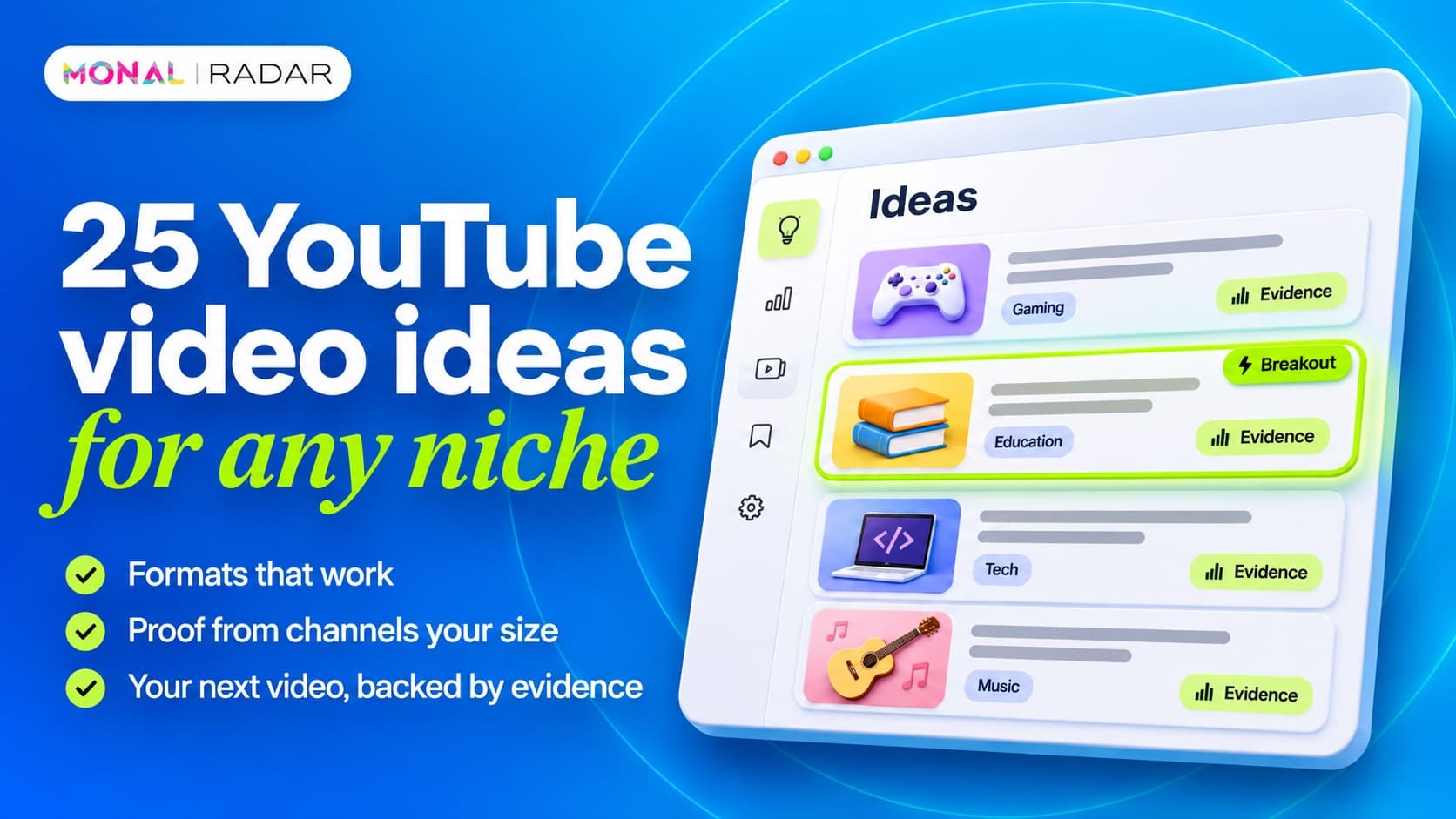
These are formats, not topics. Each one works whether you make gaming, education, music, tech, cooking or finance videos. Plug your niche into the format and you have a starting point.
Teach something
- Beginner’s guide: “How to start [skill] with zero experience.” Works for guitar, coding, chess and editing alike.
- Step-by-step tutorial: one task, solved start to finish. “How to set up a budget spreadsheet in 15 minutes.”
- Mistakes video: “7 mistakes every new [hobbyist] makes.” People search for what they’re doing wrong.
- Explainer: break down one confusing concept. “What does a camera’s ISO actually do?”
- Myth-busting: take a popular belief in your niche and test it on camera.
- Resource roundup: the tools, books or apps you actually use, and why.
Help viewers decide
- Versus video: two options, head to head. “Notion vs Obsidian for students.”
- Ranking or tier list: rank the games, gear, recipes or strategies in your niche.
- Honest review: one product after real use, with the flaws included.
- Budget vs premium: does the expensive version earn its price?
- “Is it worth it in [year]?”: revisit something people still ask about.
Show the process
- Build or make-along: a project from blank page to finished piece.
- Day in the life: your routine as a student, developer, chef or musician.
- Challenge: a time limit, a budget limit or a skill limit. “I learned to draw in 30 days.”
- Before and after: a room, a setup, a recipe or a skill level, transformed.
- Behind the scenes: how you plan, film or edit your own videos.
React and respond
- Answer your comments: turn your most-asked questions into a video.
- News breakdown: explain what just changed in your niche and what it means for viewers.
- Reaction with expertise: react to a popular video, but add knowledge the viewer doesn’t have.
- Fix a viewer’s work: review a submitted design, essay, track or gameplay clip.
Tell a story or take a side
- Story time: a real experience, told with a clear beginning, problem and outcome.
- Hot take: an opinion your niche disagrees with, argued properly.
- Deep dive: the full history or inside story of a game, company, song or event.
- Lessons learned: “What [time period] of [activity] taught me.”
- Prediction: where your niche is heading next year, with reasons.
A list like this gets you started. It can’t tell you which of these 25 will work for your channel this month. That’s the next step.
How do you find video ideas your audience is already asking for?
Your audience leaves clues every day. You find them in search suggestions, comments and your viewers’ own searches. Ideas pulled from these places start with demand already built in, so you’re answering a question instead of guessing at one.
- YouTube search suggestions: type your niche’s main topic into YouTube’s search bar and note what it suggests. Add letters (“guitar a…”, “guitar b…”) to see more.
- Comments: scan your own comments and the comments on peer channels’ videos. Repeated questions and “can you make a video on…” requests are ideas handed to you.
- YouTube Studio’s Research tab: it shows what your viewers search for across YouTube. Topics with plenty of searches and few good videos are worth a closer look.
- Communities: Reddit threads, Discord servers and forums in your niche show what people struggle with in their own words. Use those words in your titles.
Collect ideas in one list. Don’t judge them yet. Judging comes next.
How do you know which idea will work in your niche?
Look at what has already worked for channels your size, measured against each channel’s own normal. A video that does several times its channel’s usual numbers is a strong signal. It tells you the topic or format pulled in viewers beyond the channel’s regular audience.
This is where most creators go wrong. They copy the biggest channel in their niche. But a channel with millions of subscribers gets views on almost anything. Its average video tells you very little about what you should make.
A better method:
- Pick 5–10 peer channels close to your size, in your category.
- Find each channel’s normal: what a typical recent video gets.
- Spot the outliers: videos well above that channel’s normal.
- Look for patterns: the same topic or format breaking out on more than one channel is stronger evidence than a one-off.
- Check what changed: if a channel retitled a video or swapped its thumbnail, note whether views picked up afterwards.
Also keep Shorts and long-form separate. They behave differently, so an idea that took off as a Short isn’t proof it will work as a 15-minute video.
Doing this by hand works. It’s also slow, and you have to repeat it every week because your niche keeps moving.
How Monal Radar helps you pick your next video
Monal Radar does the peer research above for you, continuously. It checks the channels you watch every six hours, reads the wider market once a day, and shows you what’s taking off, with the evidence behind it.
- Breakouts: scores every video against its own channel’s normal for the same format. A breakout is a video at 3× or more of that normal, with at least 25,000 views, so a small channel’s surprise hit shows up next to a big channel’s.
- Market boards: daily rankings by size, momentum and category, so you can see which channels near your size are moving.
- Retitles: flags when a competitor changes a title or thumbnail, and whether views rose afterwards.
- Ideas: suggests video ideas grounded in what’s breaking out on the channels you watch and in the market’s proven formats. Link your channel and they also use your own analytics and your viewers’ searches. Never random ones.
- Title check: tests your title against search demand and what performs in your market, before you publish.
Every insight shows its work. Monal Radar names the channels, videos and time windows behind each recommendation, so you can judge the evidence yourself. Shorts and long-form are scored separately, and channels are compared with peers of their own size and category.
You don’t have to connect your channel to use the market boards or research. If you do, linking is read-only and you can unlink at any time. Radar never changes anything on your channel: Optimize suggests, and you make the change in YouTube Studio.
Monal Radar comes from Monal Digital, a team publishing on YouTube for 10+ years. Every feature exists because our own channel needed it first.
What mistakes should you avoid when choosing video ideas?
The biggest mistake is choosing ideas by gut feeling alone. A few others cost creators just as much time:
- Chasing every trend. A trend outside your niche brings viewers who won’t come back.
- Copying giant channels. Their results depend on their audience size, not just the idea.
- Ignoring your own data. Your best past videos tell you what your audience already wants more of.
- Repeating a topic without an edge. If the top 5 videos already cover it well, find an angle they missed or move on.
- Mixing Shorts and long-form evidence. Judge each format against its own results.
The takeaway
Ideas aren’t scarce. Evidence is. Start with a proven format, check that people want it, confirm it has worked for channels like yours, and make sure you can do it better.
If you’d rather see that evidence than dig for it, Monal Radar shows you what’s breaking out on the channels you watch and across your market, with the proof behind each idea. Know what will work before you make it.